Rhythm (By Nađa)
A mother’s pride and a seventeen-year-old’s profound lens on the melodies that heal us, the cost of a single wrong note, and the absolute necessity of self-acceptance.

Introduction:
This is a story written by my seventeen-year-old daughter, Nađa. I cannot help but feel immensely proud of her for what she has written. Her story and her perception have helped me, and I cannot wait to hear your thoughts.
Can you describe a sound that touched you so deeply the very first time you heard it?
Sound—such a simple word. Yet, within you, it can trigger countless complex sentences. Sometimes it is so quiet that you only hear it when you want to, and sometimes, you simply cannot escape it. It is everywhere, like the air. It refuses to let you forget it.
A melody. High and low tones that remind you of someone lost. Someone who used to play that melody just to remember you. For as long as the melody exists, the memories will follow. The feelings that the two of us shared, or you and I, or perhaps even them.
It will just start on its own: "tam tara ra ramp" and she will reply: "pam para ram pam", followed by a subtle smile and a glance upward, remembering.
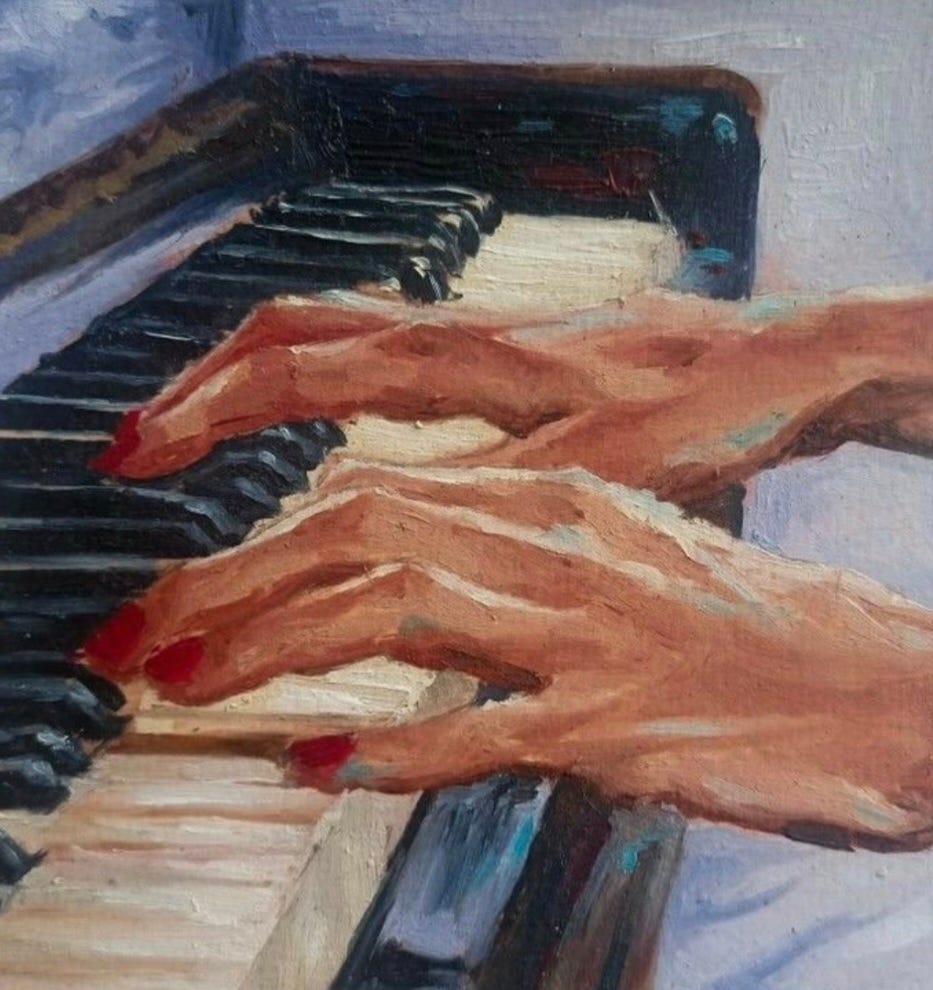
A touch of sound I will never forget: fingers slowly gliding down the piano keys, gently, barely touching them.
She sat in the room, staring at the small screen in front of her. He was playing the piano. Her attention wandered, until she heard the very first tone, produced by his index finger sharply striking the key. He began to play fiercely yet elegantly, knowing every single note by heart. She stared at the small screen with wide-open eyes and turned up the volume. His hand movements and the melody he created awakened feelings inside her that she didn't even know she possessed.
Then, abruptly, they vanished.
He finished. He missed a single note; he was only nine years old, and he just walked away. He did not love his inner melody—it was consuming him. That is why a single wrong note was enough for him to give up. For him, this performance was terrible; for her, it was incredible.
The point lies in the experience, which is entirely different for the two of them.
Mostly, we love through sound. The words we speak carry a melody. Our heartbeat, which quickens its rhythm after that someone we care about passes by. The weeping for a lost loved one also has a rhythm. Even our thoughts have a melody known only to us.
Unfortunately, there is also a not-so-beautiful melody for those who do not listen, but instead disrupt their own rhythm. They refuse to accept who they are. Why are they right here, in this very moment? Why do they write, eat, sleep, and so on? Their rhythm is always the same: "tam tam tam", and they listen to it constantly.
What if, instead of the letter "a", there stood the letter "i"?* It would sound completely different.
Acceptance.
The most important word in the entire story. Accept to be understood by your own self. Allow the rhythm to be dramatic at times, even if it isn't strictly necessary.
Because one day, the CD will stop spinning. We all know that by now.
The sound of silence you make while looking into my eyes has its own melody, one that you hear too. Except, within you, it crackles, while I am turning it up. The same goes for all of you. The sound you need is always there—but do you even want to hear it?
Since I've been a waitress my whole life, I feel like I must have a tip jar even here .
Oh this is so beautiful and it speaks to the wonderful mother that you have been to your daughter. Yes, she did a lot on her own. Yet, you provided the safe space for her to be able to think with such depth at such a young age. If her basic needs weren’t met, she would not have the mental capacity to explore such magnificent subject matter like this. She is a magnificent human being and her empathy, her awareness and her sense of self is so strong . When the winds come to sway her, as they will do many times, her ability to look inside herself and not fear the advice will bring her so much confidence and comfort on her path . I loved loved loved this . Thank you for sharing.
This is a beautifully reflective piece that uses sound as a metaphor for identity, perception, and self-acceptance. What stands out most is the way the narrative moves between external music and internal rhythm, suggesting that meaning is not located in the correctness of a note but in how it is received and experienced by another consciousness. The contrast between performance and perception becomes the emotional anchor of the essay, especially in the moment where a “wrong note” for one listener becomes something unforgettable for another. Thank you for sharing a piece that gently invites readers to consider acceptance not as resolution, but as alignment with one’s own inner rhythm.